
Impact At Anchor
Impact at Anchor
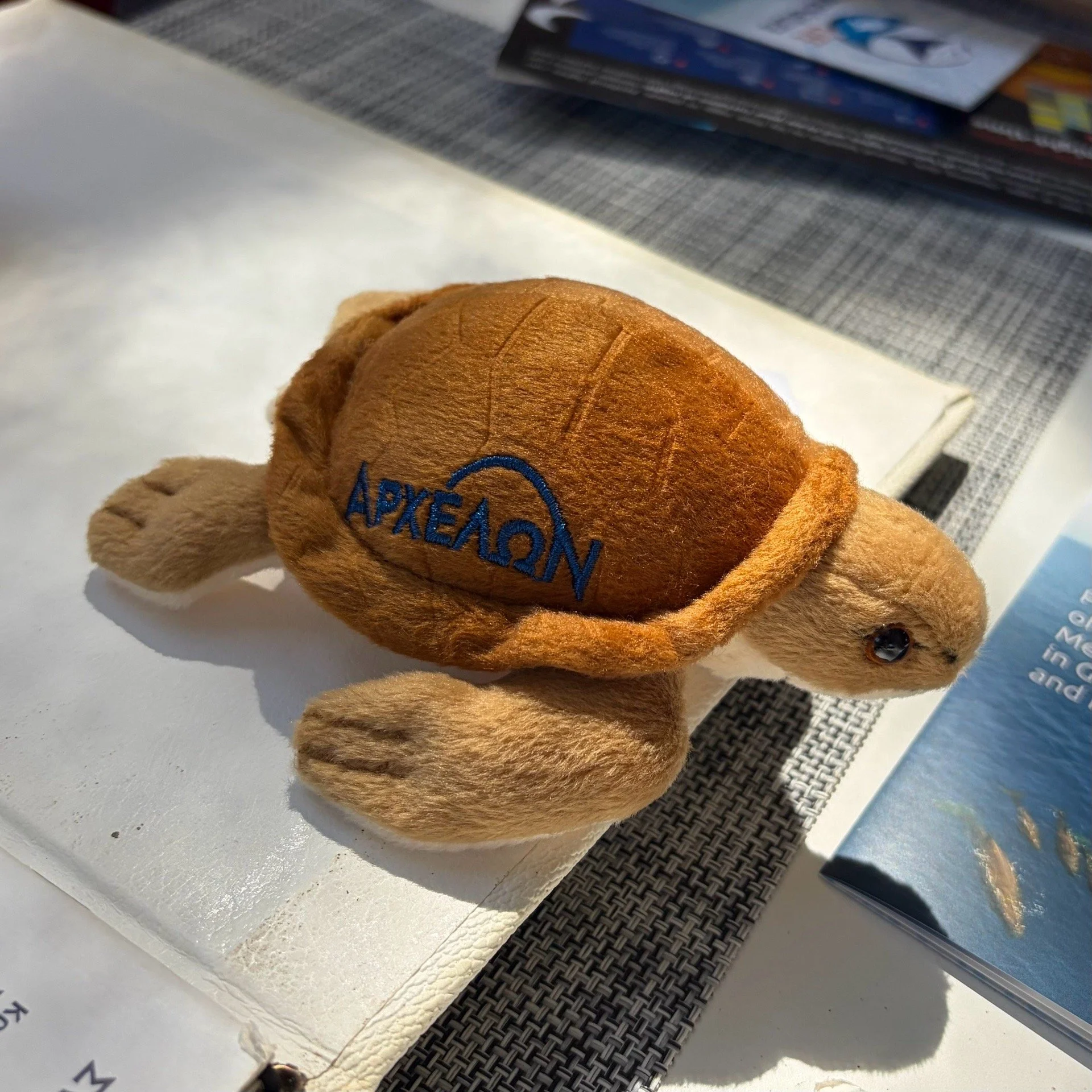
Sea Turtle Conservation with Archelon in Chania, Crete — where sustainable travel meets the coastline being actively defended, one nest at a time.
Somewhere between the whitewashed harbor of Chania and the turquoise sweep of Crete's north coast, a different kind of luxury is taking shape — one measured not in thread counts, but in nesting sites protected.
On my second excursion with Virgin Voyages' Impact Squad, I visited Archelon, the Sea Turtle Protection Society of Greece. Founded in 1983, Archelon has spent four decades safeguarding the Mediterranean's loggerhead sea turtle — Caretta caretta — running field stations across Zakynthos, the Peloponnese, and Crete, where Chania itself is one of the organization's key nesting-monitoring zones.
What struck me most wasn't the scale of the operation — it's largely volunteer-powered — but the intimacy of it. Small teams walking the same stretches of sand night after night, tagging nests, shielding them from predators and human disturbance, and easing hatchlings toward the sea they'll spend their lives navigating.
It's unglamorous, patient, essential work — and it's happening steps from some of the most photographed beaches in Greece.
For travelers drawn to conscious luxury, this is the piece that often gets left out of the itinerary: sustainability isn't just a certification on a hotel's homepage — it's a coastline being actively defended, one nest at a time.
Excursions like this one, built into a cruise's shore program, are proof that impact travel doesn't require sacrificing the itinerary's polish. It just asks you to spend a few hours somewhere that matters. Virgin Voyages' Impact Squad has been one of the most thoughtful expressions of this philosophy I've encountered at sea — positioning conservation not as an add-on but as a natural extension of how you spend a day in port.
Chania is extraordinary regardless. The harbor, the old town, the light in the late afternoon. But knowing that a few kilometers of its coastline are being walked every night by people counting turtle tracks — that knowledge makes the place feel more alive, more real, more worth protecting.
Archelon accepts donations and volunteers for their field stations across Greece each season. If you're traveling to Crete, Zakynthos, or the Peloponnese, consider reaching out directly about ways to contribute — even a single shift on the beach makes a difference to the nesting season's outcome.
Visit Archelon ↗Aligned with LuxeTerre's ongoing coverage of regenerative and ocean-focused travel, and in the spirit of the Carmen Israel Foundation's conservation work.
The best itineraries leave the places they visit better than they found them.
The Green Room · LuxeTerre Editorial
Peace Boat : The Ocean Steward
The Ocean Steward
The ocean gave me my first understanding of beauty. Then I watched it be treated as a drain. This is a story about what we owe the sea — and what happens when a ship full of people decide to act like stewards rather than spectators.
I grew up with the ocean as a given. From our family home in Haiti, the water was simply part of the landscape of childhood — impossibly blue, crystalline, the kind of clarity that lets you see straight to the ocean floor as though the sea itself were made of glass. It was not something we talked about protecting. It did not occur to us that it needed protecting. It was just there, the way the sky is just there: ancient, immovable, the backdrop against which everything else happened.
Then I came to America. And I saw what the ocean looks like here — brown in places, thick with debris, plastic bottles turning slow circles in the surf, a film on the waterline that the eye learns to stop registering because registering it is too uncomfortable. The contrast is not subtle. It is a confrontation. The same ocean. Two completely different relationships with it — one that understands the sea as something to be honored, and one that has quietly decided it is a drain.
What I have never been able to reconcile, since that first confrontation, is how deliberate it all feels. This is not neglect by oversight. The ocean is one of the great wonders of this planet — the system that produces more than half the oxygen we breathe, that absorbs over 90% of the heat our warming atmosphere generates, that sustains the livelihoods of three billion people. We know this. We have known this for a long time. And we have chosen, in policy and in practice, to treat it as a disposal site anyway.
That choice — and it is a choice — is what I want to talk about. Because I think if more travelers understood the ocean the way I understood it growing up in Haiti — as something alive, specific, and irreplaceable — they would travel very differently. And that is what this series is about.
What Peace Boat actually is — and why it matters.
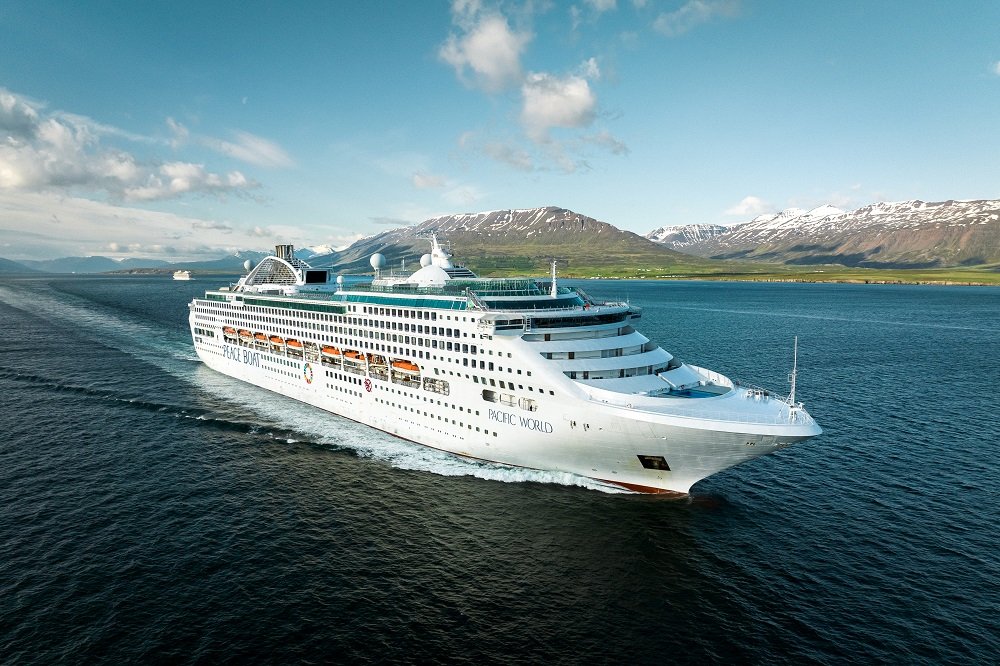
Peace Boat is not a cruise company. That distinction matters more than it might initially seem. Founded in Japan in 1983, Peace Boat is an international NGO that uses a voyage-based model to advance peace, sustainability, and human rights — carrying activists, educators, youth leaders, and advocates around the world on a ship that functions simultaneously as a floating university, a diplomatic vessel, and a platform for direct global action.
Its credentials are unimpeachable. Peace Boat holds Special Consultative Status with the United Nations Economic and Social Council. It is an active partner in the United Nations Ocean Decade. Its ship sails with the logos of the UN Sustainable Development Goals and the International Campaign to Abolish Nuclear Weapons — the 2017 Nobel Peace Laureate — painted on its hull, visiting approximately 100 countries every year. Most recently, Peace Boat co-organized an official side event at the 2025 UN Ocean Conference in Nice, focused on mobilizing youth and emerging ocean professionals — a session that filled to capacity, standing room only.
At the center of Peace Boat's environmental work is its Ocean and Climate Youth Ambassador Programme — a flagship initiative that brings young leaders from Small Island Developing States onto the ship. These are young people from Fiji, Barbados, the Seychelles, Palau, and Timor-Leste — communities where the ocean's decline is not a distant policy concern but a present, daily, existential reality — given a platform to carry their message to citizens and governments across every port the ship enters.
This is the organization I have had the privilege of working alongside. And this June, in New York City, something significant is happening aboard that ship — for the very first time.
Most travelers have never been asked to reckon with that.
What we are actually
traveling through.
The numbers around ocean health have reached a point where they should stop being background information and start being central to how we make travel decisions. The ocean absorbs roughly a third of all the carbon dioxide human activity produces — and as that carbon dissolves into seawater, it is making the ocean more acidic, threatening the coral reefs that house 25% of all marine life. Our coral reefs are not decorative. They are foundational.
Meanwhile, the plastic crisis has moved well beyond the visible. Between 75 and 199 million tonnes of plastic waste currently sit in the world's oceans. More than 11 million tonnes enter every year. Microplastics have been found in the deepest ocean trenches, in Arctic ice sheets, and in 85% of the fish we eat. The Great Pacific Garbage Patch now covers an area twice the size of Texas and contains 1.8 trillion pieces of plastic. Without decisive intervention, plastic will outweigh fish in the ocean by 2050.
The tourism industry is not innocent in this. Coastal tourism generates enormous volumes of single-use plastic. Resort development destroys mangroves and coral — the very ecosystems that make a coastline beautiful enough to visit in the first place. The industry that profits most directly from the ocean's beauty is also among the forces accelerating its decline. That is the contradiction at the heart of sustainable travel that most of the industry prefers not to name directly. I am naming it because travelers who genuinely care deserve the clarity.
What drew me to Peace Boat's work was not just the scale of what they do — it was the methodology. They understand that environmental action without community is policy without teeth. The young people they bring onto that ship are not passengers. They are the argument: living proof that the communities most affected by ocean degradation are also the ones most capable of leading the response, if we give them the platform and the resources to do so. That is a model for how every travel organization should think about its relationship to the places it moves through.
The inaugural Ocean Gala.
Aboard the ship. In New York.
On the evening of June 10th — two days after United Nations World Oceans Day — Peace Boat US will host the first-ever Ocean Gala and Blue Innovation Reception aboard the Peace Boat ship, docked at the Manhattan Cruise Terminal. This is an inaugural event. There has never been one before. And the timing, the venue, and the guest list make it one of the most significant ocean-focused gatherings of the year in New York City.
The Gala will bring together partners from the United Nations, private sector leaders, youth ocean advocates, blue economy innovators, and civil society organizations — all aboard a ship that has circumnavigated the globe in service of exactly these values. The evening opens with the Ocean Gala at 5pm, transitioning into a Blue Innovation Reception at 7:30pm, with appetizers and drinks served onboard. The dress code is Blue Tie and ocean-inspired. Formal, purposeful, and unlike any event happening in this city this June.
Peace Boat US will also be announcing the inaugural Ocean Stewardship Awards for SDG 14: Life Below Water — celebrating the individuals, organizations, and innovators putting the ocean at the forefront of marine research, conservation, and nature-based solutions. The award alone signals what kind of room this will be.
LuxeTerre is proud to be part of this evening. And we want to bring our community with us. Use code LUXETERRE at checkout for $25 off your ticket.
The Ocean Gala &
Blue Innovation Reception
An evening onboard Peace Boat with UN partners, blue economy leaders, youth ocean advocates, and civil society — in celebration of World Oceans Day and the UN Decade of Ocean Science. Appetizers and drinks served onboard. Valid government-issued photo ID required. All attendees must register independently.
Use code LUXETERRE at checkout · Registration closes June 1 · Tickets not transferable
I believe the most powerful thing the conscious travel community can do right now is show up — physically, financially, and publicly — for the organizations doing the hardest work on ocean health. Peace Boat has been doing that work for over four decades. The Ocean Gala is an opportunity to stand in the same room as the people who are refusing to look away from what is happening to our seas, and to add your presence and your voice to that refusal.
Over the next four weeks, I will be bringing you deeper into this story — into what Peace Boat's programs actually look like on the ground, into what an evening like this means in the broader context of ocean governance, and into what LuxeTerre's collaboration with Peace Boat is building toward. This is week one. There is much more to come.
June 10th. Manhattan Cruise Terminal. Aboard Peace Boat. Code LUXETERRE for $25 off. Come be part of it.

The Slow Travel Shift
The Slow Travel Shift:
Why Less Movement Means More Experience
Speed used to be the currency of sophisticated travel. Now the most discerning travelers are doing the opposite — staying longer, moving less, and returning home with something that a whirlwind itinerary cannot produce: the feeling of having actually been somewhere.
Imagine this. It is Tuesday morning in a hill town in Tuscany — not a Tuesday you are passing through on the way to somewhere else, but a Tuesday that simply belongs to you. The market has been running since seven. The butcher knows you by now. You have had the same table at the bar on the corner three mornings in a row, and the owner has stopped handing you a menu. You walked the same road yesterday evening and noticed something you had missed the day before — a carved lintel above a door, a view that only opens up at a particular angle, a dog that sleeps in the same square every afternoon. You are not sightseeing. You are, quietly and without ceremony, living.
This is slow travel. Not a trend, not a retreat from ambition, and not a compromise. It is a philosophy of intentional movement — one that holds that depth of experience and breadth of itinerary are, for the most part, in direct opposition to each other. And in 2026, it has become the defining shift in how the world's most thoughtful travelers approach their journeys.
The numbers are unambiguous. Research from the University of Leeds found that journeys of more than 50 miles account for less than 3% of all trips taken by UK residents — but are responsible for 70% of all passenger travel-related carbon emissions. International flights alone, just 0.4% of total trips, generate 55% of emissions. The implication is stark: the single most effective change a traveler can make is not switching to a reusable water bottle at the airport. It is taking fewer, longer trips.
But slow travel is not a sacrifice dressed up in sustainability language. It is a genuinely superior way to travel — and the evidence for that is just as compelling as the environmental data. A survey of 2,000 Americans found that mental health improvements from travel are significantly amplified by slower, more immersive experiences. The time pressure that turns vacations into their own form of stress — the packed schedule, the missed connection, the sense that you never quite arrived before it was already time to leave — evaporates when the itinerary is designed around depth rather than distance.
what does it actually feel like to be somewhere?
Three principles.
One way of moving through the world.
The slow travel movement grew from the Slow Food movement launched in Italy in 1986 — Carlo Petrini's protest against the opening of a McDonald's near the Spanish Steps in Rome, and his insistence that the pace at which we consume shapes the quality of what we receive. By the late 1990s, the philosophy had migrated from the table to the journey itself. Its core logic is simple: prioritize quality over speed, depth over breadth, presence over documentation.
At LuxeTerre, we interpret slow travel as a philosophy built on three inseparable principles. The first is staying longer in fewer places — resisting the checklist mentality that turns a two-week trip into a relay race across six cities, and instead choosing one or two destinations and giving them the time they deserve. The second is moving between places by lower-carbon means wherever possible: train over plane, ship over flight, road trip over connection. Not as penance, but because the journey by train through the Swiss Alps or along the Italian coast is, by almost any measure, a better experience than a departure gate. The third is immersive local living — eating where residents eat, shopping where residents shop, learning a neighborhood's rhythms rather than photographing its landmarks.
These are not rules. They are orientations. And they require planning — which is precisely where most travelers, even those who deeply want to travel this way, get stuck.
Five slow travel journeys
bookable through LuxeTerre.
Tuscany, Italy — Extended Villa Stay
Tuscany is the archetype of slow travel for good reason — it rewards time in a way that few places do. A week in a single hilltop village yields entirely different returns from a four-day grand tour of Florence, Siena, and San Gimignano. The olive harvest in October, the wildflower-covered Val d'Orcia in May, the rhythm of a market town on a Thursday morning — none of these are available to the traveler moving at speed.
Belmond's Venice Simplon-Orient-Express launched a Paris to Tuscany route in 2025, pairing the legendary rail journey with an extended stay at Castello di Casole — one of the finest estate hotels in Italy, set among 4,200 acres of working Tuscan farmland. For those arriving by high-speed rail from Rome, the journey takes 90 minutes and deposits you directly into the soul of the region. LuxeTerre curates extended stays across a range of Tuscan properties, from intimate agritourismos to restored Renaissance estates, with locally guided itineraries designed around the season.
Japan — Ryokan Circuit by Rail
Japan's rail network is the finest in the world, which makes it one of the most naturally suited countries on earth for slow travel by train. A ryokan circuit — moving between traditional Japanese inns in Kyoto, Hakone, Kanazawa, and the Izu Peninsula — covers remarkable cultural and geographic ground while keeping the pace deliberately unhurried. Each ryokan demands a certain slowness by design: the kaiseki dinner is a multi-hour event, the onsen ritual has its own protocols, the tatami room and its absence of furniture invites a particular quality of stillness.
Japan's JR Group also operates its extraordinary Joyful Trains — specialist tourism trains including dining cars, observation cars, and the Shiki-Shima, a five-star sleeper train that operates in limited departures through Japan's most remote and beautiful landscapes. A slow travel itinerary in Japan is not a compromise on experience. It is an amplification of everything that makes Japan extraordinary — and it produces a fraction of the carbon footprint of a multi-flight Asian tour.
Provence, France — One Region, Fully Lived
Provence is a region that has been photographed so extensively that it can feel, in anticipation, slightly exhausted by its own beauty. Arriving slowly — by TGV from Paris, followed by a rental car or private transfer into the Luberon — and staying in one village for ten days is the antidote to that exhaustion. The lavender doesn't bloom on a schedule calibrated to your departure date. The light in the late afternoon is different from the light at midday in a way that takes more than one day to notice. The Tuesday market in Apt and the Saturday market in Aix-en-Provence are not interchangeable; each has its own character, its own vendors, its own pace.
A slow travel Provence itinerary built by LuxeTerre centers on a single base property — a mas, a bastide, or a village house — with day excursions rather than nightly relocations. Les Bateaux Belmond, which operates a fleet of floating villas along the rivers and canals of Provence, offers another dimension: the Rhône and the Canal du Midi traveled at a walking pace, with stops determined by appetite and curiosity rather than a fixed timetable.
England & Wales — Britannic Explorer Sleeper Train
Belmond launched the Britannic Explorer in July 2025 — the first luxury sleeper train in England and Wales, and one of the most genuinely compelling new slow travel products in years. Three-night and six-night itineraries depart from London and wind through Cornwall's dramatic coastline, the Lake District's fells, and the wild landscapes of Wales, with off-train excursions — open-water swimming on Derwentwater, exclusive access to historic estates, hikes through national parks — curated by Belmond and executed by local experts.
Dining is overseen by Michelin-starred chef Simon Rogan, whose farm-to-fork philosophy is among the most rigorous in British gastronomy. The train itself — 18 cabins across Suites and Grand Suites, a wellness suite, two restaurant cars, and an observation bar — makes the argument that the most elegant way to see Britain is from a moving window at night, waking to a landscape you chose to be inside rather than to photograph from outside. This is slow travel at its most elevated.
Croatia — Island Hopping by Private Sail
Croatia's Dalmatian coast — Hvar, Korčula, Vis, Brač — is one of the great arguments for slow travel by sea. Each island has a distinct character, a distinct cuisine, and a distinct rhythm, and the ferry connections between them are frequent enough that there is no pressure to rush. A private sailing charter takes this further: the itinerary is yours, the pace is yours, and the hidden coves accessible only by water are yours in a way they can never be from a tour bus or a fast ferry.
A week on the Adriatic by sail reduces your transport carbon footprint to near zero, immerses you in a culture that is genuinely different from the Croatian mainland experience, and produces the particular quality of relaxation that comes from having no fixed schedule beyond the wind and the tide. LuxeTerre curates both crewed charter experiences and guided sailing itineraries across the Dalmatian islands, with accommodation ranging from private villas on arrival to boutique hotels in the old towns of Hvar and Korčula.
The world has not gotten smaller.
We have just been moving through it too fast to notice.
The case for slow travel is both environmental and deeply personal. It asks nothing of you that a well-planned itinerary cannot deliver — and it returns things that no itinerary, however well-planned, can manufacture: the sensation of belonging somewhere for long enough to have a routine, the particular knowledge that comes from returning to the same place twice, the memory of a Tuesday morning that felt like it belonged to you.
The practical objection is always time. But slow travel does not require more time — it requires different time. One trip of fourteen days to a single destination uses the same annual leave as two trips of seven days to six countries. The question is not whether you have the time. The question is what you want to come home with.
LuxeTerre Travel, powered by FORA, specializes in exactly this kind of itinerary: deeply considered, unhurried, and built around your specific definition of what it means to travel well. We do not sell packages. We curate journeys. And we believe the best ones are the ones that feel, by the end, like they could have gone on a little longer.
Ready to travel
differently?
Slow travel itineraries, fully curated. No planning fees. No guesswork. Just beautifully considered journeys that give you the time to actually arrive.
Plan Your Journey →
The Green Gap
The Green Gap:
Why Reading About Sustainable Travel Isn't the Same as Doing It
The eco-travel internet has never been richer — or more overwhelming. Stunning guides, carbon calculators, destination manifestos. And yet, somehow, you're still on your own. There is a better way.
Let's give credit where it's due. The sustainable travel content ecosystem has done something remarkable: it has shifted consciousness at scale. Blogs like Sustainable Travel International, The Eco Experts, and Responsible Travel have educated millions of readers on the virtues of slow travel, carbon offsetting, community-based tourism, and the quiet devastation of overtourism. They have made "impact" a word that now belongs in the same sentence as "holiday."
And yet — there is a gap. A wide, logistically treacherous gap between knowing and doing.
The numbers tell a story the content doesn't. Intention is abundant. Execution is scarce. Because reading a beautifully written piece on the regenerative lodges of Costa Rica does not tell you which operator has LGBTQ-inclusive policies, or which private transfer company pays its drivers a living wage, or how to sequence an itinerary that minimizes internal flights while maximizing time. That work — the real work — is still left entirely to you.
It rarely tells you exactly how to get there.
There is no shortage of information. That, paradoxically, is the problem. A conscientious traveler researching an eco-minded trip to Japan might spend 30 hours across blogs, Reddit threads, certification databases, and hotel review sites — only to make booking decisions under pressure, with significant uncertainty still intact. The cognitive load is enormous, and the vetting process is, frankly, a full-time job.
Most sustainable travel content is not designed to close a booking. It is designed to inform a mindset. That's not a criticism — it's simply the nature of editorial work. The Condé Nast green hotel round-up does not know your travel dates, your dietary restrictions, your preferred pace of movement, or the fact that you need a wheelchair-accessible property with a spa that sources locally. The algorithm doesn't know you. The article was not written for you.
The LuxeTerre DifferenceThis is precisely where LuxeTerre Travel enters — and where the conversation changes entirely.
Powered by FORA, one of the most respected travel agency platforms in the industry, LuxeTerre Travel is not a content destination. It is a curation and execution partner. The distinction matters deeply. Where the eco-travel blog hands you a list and wishes you well, LuxeTerre takes the list, interrogates it, verifies it against current sustainability certifications, and builds a journey around your specific life — your values, your timeline, your definition of luxury, and your commitment to leaving places better than you found them.
Every recommendation is vetted. Every property is evaluated not just for aesthetics, but for ethics. Carbon impact. Community investment. Labor practices. Biodiversity commitments. These are not afterthoughts in the LuxeTerre framework — they are the framework.
And because LuxeTerre operates at the intersection of sustainability advocacy and genuine luxury fluency — rooted in years of global sustainability work and the Miss Earth USA ECO platform — the curation carries a credibility that no algorithm can replicate. This is not greenwashing dressed in beautiful photography. This is accountability with an itinerary attached.
The sustainable travel movement has earned its moment. The content is extraordinary. The intention across the traveling public is real. What has been missing — until now — is a partner who can translate that intention into a seamless, vetted, logistically flawless journey that doesn't ask you to become an expert just to take a vacation.
You've done the reading. Let LuxeTerre handle the rest.
Your values, fully itineraried.
Bespoke sustainable travel curation for the intentional luxury traveler. No guesswork. No greenwashing. Just beautifully considered journeys.
Plan Your Journey →