
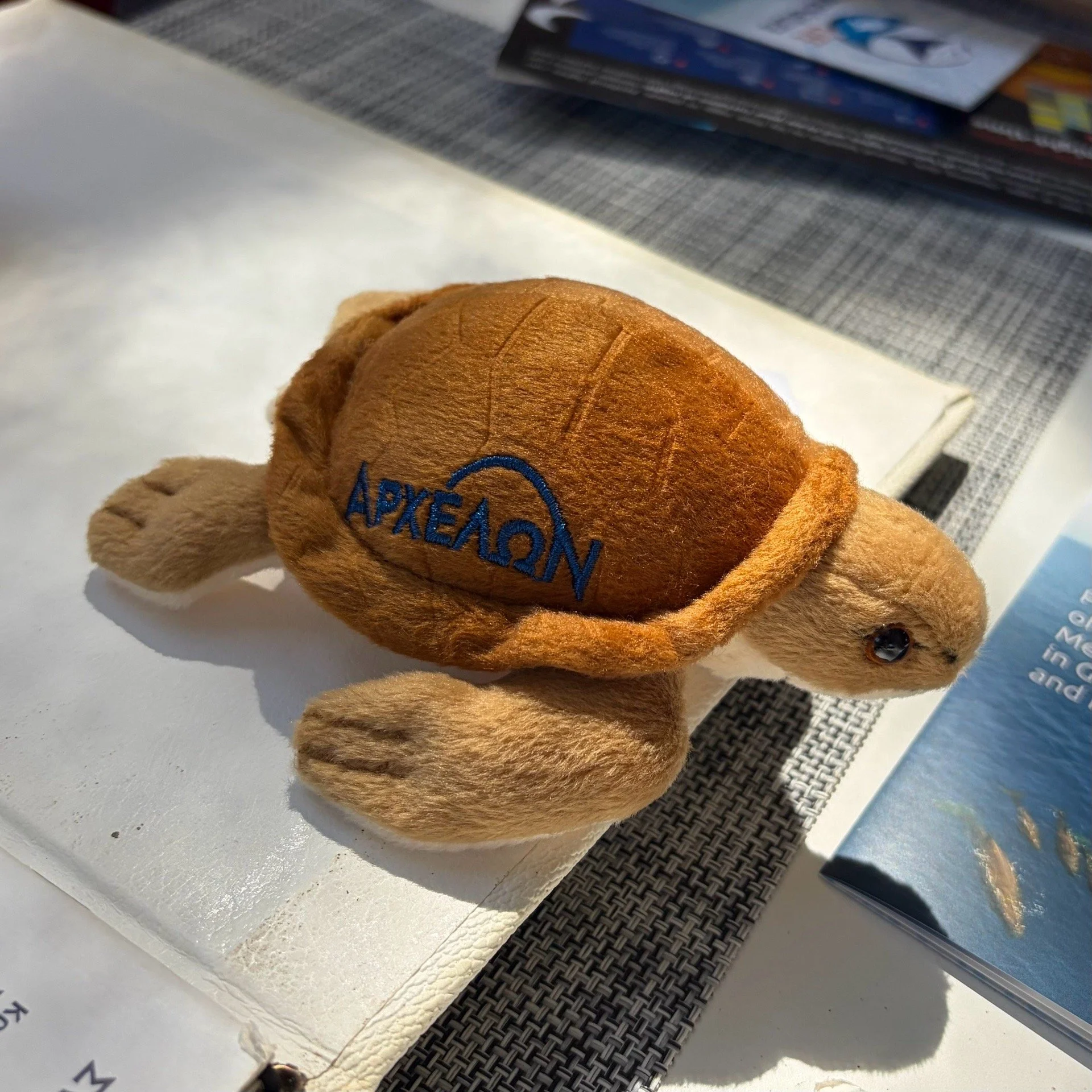
Impact At Anchor
Impact at Anchor
Sea Turtle Conservation with Archelon in Chania, Crete — where sustainable travel meets the coastline being actively defended, one nest at a time.
Somewhere between the whitewashed harbor of Chania and the turquoise sweep of Crete's north coast, a different kind of luxury is taking shape — one measured not in thread counts, but in nesting sites protected.
On my second excursion with Virgin Voyages' Impact Squad, I visited Archelon, the Sea Turtle Protection Society of Greece. Founded in 1983, Archelon has spent four decades safeguarding the Mediterranean's loggerhead sea turtle — Caretta caretta — running field stations across Zakynthos, the Peloponnese, and Crete, where Chania itself is one of the organization's key nesting-monitoring zones.
What struck me most wasn't the scale of the operation — it's largely volunteer-powered — but the intimacy of it. Small teams walking the same stretches of sand night after night, tagging nests, shielding them from predators and human disturbance, and easing hatchlings toward the sea they'll spend their lives navigating.
It's unglamorous, patient, essential work — and it's happening steps from some of the most photographed beaches in Greece.
For travelers drawn to conscious luxury, this is the piece that often gets left out of the itinerary: sustainability isn't just a certification on a hotel's homepage — it's a coastline being actively defended, one nest at a time.
Excursions like this one, built into a cruise's shore program, are proof that impact travel doesn't require sacrificing the itinerary's polish. It just asks you to spend a few hours somewhere that matters. Virgin Voyages' Impact Squad has been one of the most thoughtful expressions of this philosophy I've encountered at sea — positioning conservation not as an add-on but as a natural extension of how you spend a day in port.
Chania is extraordinary regardless. The harbor, the old town, the light in the late afternoon. But knowing that a few kilometers of its coastline are being walked every night by people counting turtle tracks — that knowledge makes the place feel more alive, more real, more worth protecting.
Archelon accepts donations and volunteers for their field stations across Greece each season. If you're traveling to Crete, Zakynthos, or the Peloponnese, consider reaching out directly about ways to contribute — even a single shift on the beach makes a difference to the nesting season's outcome.
Visit Archelon ↗Aligned with LuxeTerre's ongoing coverage of regenerative and ocean-focused travel, and in the spirit of the Carmen Israel Foundation's conservation work.
The best itineraries leave the places they visit better than they found them.
The Green Room · LuxeTerre Editorial
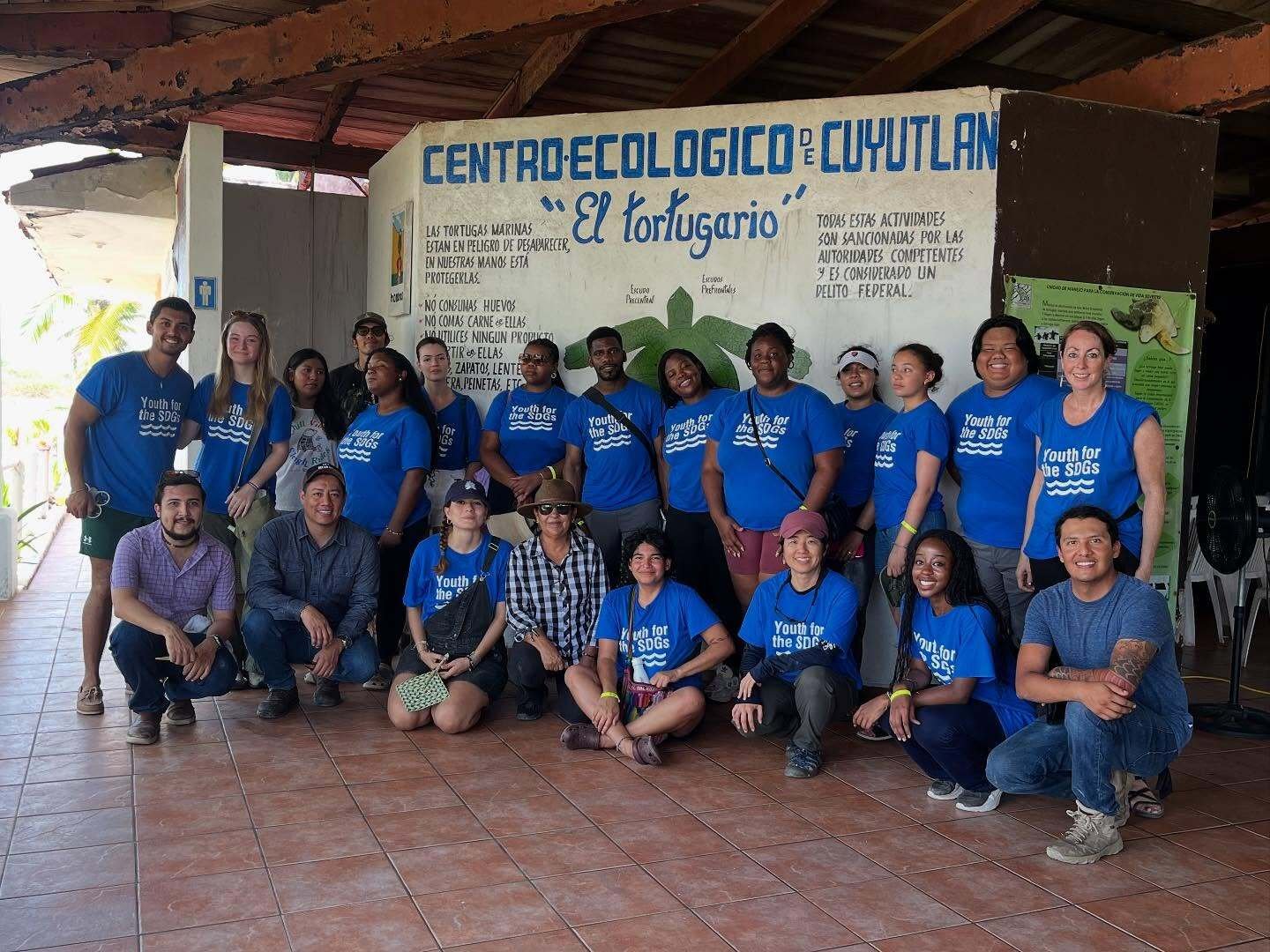
Peace Boat: On the Frontline
On the Frontline
Behind every statistic about the ocean's decline, there is a person who woke up this morning knowing that the water surrounding their home is rising. Peace Boat understood something essential: those people are not the problem to be solved. They are the leaders we have been waiting for.
Last week I wrote about the ocean I grew up with in Haiti — crystalline, blue to the floor, something I took for granted until I came to America and saw what deliberate neglect looks like in a body of water. That contrast — between what the ocean is and what we have made of it — is the reason I believe so strongly in the work Peace Boat does. Because Peace Boat is not an organization that talks about the ocean from a distance. It is an organization that puts the people closest to the crisis on a ship and sends them out into the world to testify.
This week, I want to introduce you to that work more closely. To the programme at the heart of it. To the countries it represents. And to the voices it has amplified — young people from nations whose entire existence is, right now, contingent on what the rest of the world decides to do about the ocean and the climate. People for whom this is not advocacy. It is survival.
are not the ones that caused it.
The Ocean and Climate
Youth Ambassador Programme.
Launched at the United Nations Ocean Conference in 2017, Peace Boat's Ocean and Climate Youth Ambassador Programme is one of the most specific and human responses to the ocean crisis that exists anywhere in the world. Its premise is simple and its execution is rigorous: bring young leaders from the Small Island Developing States — the nations most immediately threatened by rising seas, warming waters, and marine degradation — onto Peace Boat's ship, and send them across the globe to tell their stories to citizens, journalists, civil society organizations, and government representatives in every port the ship enters.
The programme is not a symbolic gesture. It is a certified voluntary commitment under the UN Sustainable Development Goals, formally recognized by the United Nations. Peace Boat is an endorsed actor in the UN Ocean Decade. And the programme has an explicit mandate: amplify the voices that global environmental policy most urgently needs to hear, from the communities that policy most urgently needs to serve.
Over three editions of the programme, Peace Boat has provided capacity development for twenty-six youth leaders. The fourth edition expanded the programme further, adding an alumni network to allow graduates to continue working together across their home communities in the Pacific, Indian Ocean, and Caribbean long after the voyage ends. A fifth edition focused on youth from across the African continent was launched in partnership with the Africa Europe Foundation and the World Resources Institute following COP27. The programme keeps growing because the crisis it responds to keeps growing.
What actually happens
on the ship.
The programme is not simply passage. The time aboard Peace Boat is structured and intensive — a floating curriculum designed to take young people who are already advocates in their own communities and give them the skills, the networks, and the platform to become advocates on a global stage.
Onboard workshops covering media skills, climate negotiation, campaigning strategy, and how to engage effectively with government representatives and international bodies.
In each city the ship enters, ambassadors hold press conferences, public events, and meetings with local officials and civil society organizations — carrying their testimony directly to communities around the world.
Ambassadors share the cultural heritage of their home islands with other passengers and port communities — making visible what is at risk, not just ecologically, but culturally and historically.
Graduates return home with a global network of youth leaders and access to an ongoing platform for coordinated action across the Pacific, Indian Ocean, and Caribbean regions.
Guest educators join the programme onboard at various points in the voyage — including representatives from the UN Framework Convention on Climate Change and senior figures from partner organizations. The ambassadors are not students being taught. They are leaders being equipped.
The countries that cannot
afford for us to look away.
The ambassadors who have participated in the programme to date come from twelve nations across three ocean regions. Each of these countries shares a reality that the industrialized world has largely been able to insulate itself from: the ocean is not a metaphor for them. It is the boundary of their existence — and that boundary is moving inward, season by season, storm by storm.
Tuvalu's highest point is less than five meters above sea level. Kiribati is composed entirely of coral atolls — some of which are already being swallowed by the rising Pacific. The Marshall Islands have been negotiating with neighboring nations for decades about what statehood looks like when your land disappears beneath the water. These are not hypothetical futures. They are present realities, experienced by millions of people who did not cause the crisis that is consuming their homes.
This is the injustice that the programme forces into view — not through statistics, but through people. Through a young woman from the Seychelles at a climate conference in Egypt, speaking into a microphone about what it means to watch a coastline she grew up on recede year by year. Through a youth leader from Palau standing on the deck of a ship in open water, telling an interviewer that the beauty of the ocean is magical — and terrifying — because if the current rate of change continues, the ocean may be the only thing left of the Pacific islands he calls home.
"Stepping out onto the deck once we reached open ocean was an incredible experience, because the beauty of the ocean is magical, but also incredibly terrifying. Because if the current rate of climate change continues, the ocean may be the only thing left of the Pacific islands I call home."
"As a native of Palau, a Small Island Developing State, my world has always revolved around the ocean. The rising tides, shifting weather patterns, and ecosystem balance between people and nature are more than talking points to me — they make up the fabric of daily life."
Why this matters to
every traveler.
Many of the nations represented in Peace Boat's programme are among the world's most visited destinations. Palau's marine sanctuary is one of the most celebrated in the world. The Seychelles is on the bucket list of every serious traveler who has ever looked at a photograph of turquoise water over white sand. The Maldives, the Caribbean islands, Fiji — these are not remote abstractions. They are places that the global travel industry has built entire economies around. And they are the places most threatened by the behavior of that same industry.
There is something important in that. Not as a reason for guilt, but as a reason for responsibility. When you travel to Palau, you are a guest in a place that is fighting for its own survival while simultaneously offering you one of the most extraordinary natural experiences on earth. The least that kind of hospitality deserves is travelers who show up understanding what is at stake — and who make choices accordingly.
That is what conscious travel actually means. Not just choosing the hotel with the green certification, but understanding the broader system you are moving through. The ocean is that system. And the young people Peace Boat puts on that ship are, in every sense, its most credible spokespeople.
What I keep coming back to, when I think about the Youth Ambassador Programme, is that it is not asking anything of these young people that they haven't already been doing their entire lives. They have been living with the consequences of the ocean crisis since they were born. The programme just gives them a ship, an audience, and the tools to make sure that living means something beyond the borders of their own islands. That is, I think, the most elegant form of advocacy I have ever encountered.
On June 10th, this work
comes to New York.
The inaugural Ocean Gala and Blue Innovation Reception on June 10th is the first time Peace Boat has created an event of this scale in the United States — and it is, in essence, a public gathering of exactly the kind of community the Youth Ambassador Programme has been building for nearly a decade. UN partners, blue economy innovators, ocean scientists, civil society leaders, and youth advocates from Small Island Developing States, all aboard a ship that has carried their stories across a hundred countries. All in the same room. For one evening.
One of the evening's centerpieces is the announcement of the inaugural Ocean Stewardship Awards for SDG 14: Life Below Water — honoring the individuals and organizations doing the most consequential work on behalf of the ocean right now. It is a room that takes the ocean seriously. It is a room worth being in. And with registration closing June 1, time is genuinely short.
The Ocean Gala & Blue Innovation Reception
Manhattan Cruise Terminal · 4pm Check-in · 5pm Gala · 7:30pm Reception
Registration closes June 1. Valid photo ID required.
Next week in this series: L'Edit Bleu — the curated sustainable designer showcase LuxeTerre is bringing to the Ocean Gala. The full story of what we are building aboard that ship, and the New York designers who are bringing it to life.

The Slow Travel Shift
The Slow Travel Shift:
Why Less Movement Means More Experience
Speed used to be the currency of sophisticated travel. Now the most discerning travelers are doing the opposite — staying longer, moving less, and returning home with something that a whirlwind itinerary cannot produce: the feeling of having actually been somewhere.
Imagine this. It is Tuesday morning in a hill town in Tuscany — not a Tuesday you are passing through on the way to somewhere else, but a Tuesday that simply belongs to you. The market has been running since seven. The butcher knows you by now. You have had the same table at the bar on the corner three mornings in a row, and the owner has stopped handing you a menu. You walked the same road yesterday evening and noticed something you had missed the day before — a carved lintel above a door, a view that only opens up at a particular angle, a dog that sleeps in the same square every afternoon. You are not sightseeing. You are, quietly and without ceremony, living.
This is slow travel. Not a trend, not a retreat from ambition, and not a compromise. It is a philosophy of intentional movement — one that holds that depth of experience and breadth of itinerary are, for the most part, in direct opposition to each other. And in 2026, it has become the defining shift in how the world's most thoughtful travelers approach their journeys.
The numbers are unambiguous. Research from the University of Leeds found that journeys of more than 50 miles account for less than 3% of all trips taken by UK residents — but are responsible for 70% of all passenger travel-related carbon emissions. International flights alone, just 0.4% of total trips, generate 55% of emissions. The implication is stark: the single most effective change a traveler can make is not switching to a reusable water bottle at the airport. It is taking fewer, longer trips.
But slow travel is not a sacrifice dressed up in sustainability language. It is a genuinely superior way to travel — and the evidence for that is just as compelling as the environmental data. A survey of 2,000 Americans found that mental health improvements from travel are significantly amplified by slower, more immersive experiences. The time pressure that turns vacations into their own form of stress — the packed schedule, the missed connection, the sense that you never quite arrived before it was already time to leave — evaporates when the itinerary is designed around depth rather than distance.
what does it actually feel like to be somewhere?
Three principles.
One way of moving through the world.
The slow travel movement grew from the Slow Food movement launched in Italy in 1986 — Carlo Petrini's protest against the opening of a McDonald's near the Spanish Steps in Rome, and his insistence that the pace at which we consume shapes the quality of what we receive. By the late 1990s, the philosophy had migrated from the table to the journey itself. Its core logic is simple: prioritize quality over speed, depth over breadth, presence over documentation.
At LuxeTerre, we interpret slow travel as a philosophy built on three inseparable principles. The first is staying longer in fewer places — resisting the checklist mentality that turns a two-week trip into a relay race across six cities, and instead choosing one or two destinations and giving them the time they deserve. The second is moving between places by lower-carbon means wherever possible: train over plane, ship over flight, road trip over connection. Not as penance, but because the journey by train through the Swiss Alps or along the Italian coast is, by almost any measure, a better experience than a departure gate. The third is immersive local living — eating where residents eat, shopping where residents shop, learning a neighborhood's rhythms rather than photographing its landmarks.
These are not rules. They are orientations. And they require planning — which is precisely where most travelers, even those who deeply want to travel this way, get stuck.
Five slow travel journeys
bookable through LuxeTerre.
Tuscany, Italy — Extended Villa Stay
Tuscany is the archetype of slow travel for good reason — it rewards time in a way that few places do. A week in a single hilltop village yields entirely different returns from a four-day grand tour of Florence, Siena, and San Gimignano. The olive harvest in October, the wildflower-covered Val d'Orcia in May, the rhythm of a market town on a Thursday morning — none of these are available to the traveler moving at speed.
Belmond's Venice Simplon-Orient-Express launched a Paris to Tuscany route in 2025, pairing the legendary rail journey with an extended stay at Castello di Casole — one of the finest estate hotels in Italy, set among 4,200 acres of working Tuscan farmland. For those arriving by high-speed rail from Rome, the journey takes 90 minutes and deposits you directly into the soul of the region. LuxeTerre curates extended stays across a range of Tuscan properties, from intimate agritourismos to restored Renaissance estates, with locally guided itineraries designed around the season.
Japan — Ryokan Circuit by Rail
Japan's rail network is the finest in the world, which makes it one of the most naturally suited countries on earth for slow travel by train. A ryokan circuit — moving between traditional Japanese inns in Kyoto, Hakone, Kanazawa, and the Izu Peninsula — covers remarkable cultural and geographic ground while keeping the pace deliberately unhurried. Each ryokan demands a certain slowness by design: the kaiseki dinner is a multi-hour event, the onsen ritual has its own protocols, the tatami room and its absence of furniture invites a particular quality of stillness.
Japan's JR Group also operates its extraordinary Joyful Trains — specialist tourism trains including dining cars, observation cars, and the Shiki-Shima, a five-star sleeper train that operates in limited departures through Japan's most remote and beautiful landscapes. A slow travel itinerary in Japan is not a compromise on experience. It is an amplification of everything that makes Japan extraordinary — and it produces a fraction of the carbon footprint of a multi-flight Asian tour.
Provence, France — One Region, Fully Lived
Provence is a region that has been photographed so extensively that it can feel, in anticipation, slightly exhausted by its own beauty. Arriving slowly — by TGV from Paris, followed by a rental car or private transfer into the Luberon — and staying in one village for ten days is the antidote to that exhaustion. The lavender doesn't bloom on a schedule calibrated to your departure date. The light in the late afternoon is different from the light at midday in a way that takes more than one day to notice. The Tuesday market in Apt and the Saturday market in Aix-en-Provence are not interchangeable; each has its own character, its own vendors, its own pace.
A slow travel Provence itinerary built by LuxeTerre centers on a single base property — a mas, a bastide, or a village house — with day excursions rather than nightly relocations. Les Bateaux Belmond, which operates a fleet of floating villas along the rivers and canals of Provence, offers another dimension: the Rhône and the Canal du Midi traveled at a walking pace, with stops determined by appetite and curiosity rather than a fixed timetable.
England & Wales — Britannic Explorer Sleeper Train
Belmond launched the Britannic Explorer in July 2025 — the first luxury sleeper train in England and Wales, and one of the most genuinely compelling new slow travel products in years. Three-night and six-night itineraries depart from London and wind through Cornwall's dramatic coastline, the Lake District's fells, and the wild landscapes of Wales, with off-train excursions — open-water swimming on Derwentwater, exclusive access to historic estates, hikes through national parks — curated by Belmond and executed by local experts.
Dining is overseen by Michelin-starred chef Simon Rogan, whose farm-to-fork philosophy is among the most rigorous in British gastronomy. The train itself — 18 cabins across Suites and Grand Suites, a wellness suite, two restaurant cars, and an observation bar — makes the argument that the most elegant way to see Britain is from a moving window at night, waking to a landscape you chose to be inside rather than to photograph from outside. This is slow travel at its most elevated.
Croatia — Island Hopping by Private Sail
Croatia's Dalmatian coast — Hvar, Korčula, Vis, Brač — is one of the great arguments for slow travel by sea. Each island has a distinct character, a distinct cuisine, and a distinct rhythm, and the ferry connections between them are frequent enough that there is no pressure to rush. A private sailing charter takes this further: the itinerary is yours, the pace is yours, and the hidden coves accessible only by water are yours in a way they can never be from a tour bus or a fast ferry.
A week on the Adriatic by sail reduces your transport carbon footprint to near zero, immerses you in a culture that is genuinely different from the Croatian mainland experience, and produces the particular quality of relaxation that comes from having no fixed schedule beyond the wind and the tide. LuxeTerre curates both crewed charter experiences and guided sailing itineraries across the Dalmatian islands, with accommodation ranging from private villas on arrival to boutique hotels in the old towns of Hvar and Korčula.
The world has not gotten smaller.
We have just been moving through it too fast to notice.
The case for slow travel is both environmental and deeply personal. It asks nothing of you that a well-planned itinerary cannot deliver — and it returns things that no itinerary, however well-planned, can manufacture: the sensation of belonging somewhere for long enough to have a routine, the particular knowledge that comes from returning to the same place twice, the memory of a Tuesday morning that felt like it belonged to you.
The practical objection is always time. But slow travel does not require more time — it requires different time. One trip of fourteen days to a single destination uses the same annual leave as two trips of seven days to six countries. The question is not whether you have the time. The question is what you want to come home with.
LuxeTerre Travel, powered by FORA, specializes in exactly this kind of itinerary: deeply considered, unhurried, and built around your specific definition of what it means to travel well. We do not sell packages. We curate journeys. And we believe the best ones are the ones that feel, by the end, like they could have gone on a little longer.
Ready to travel
differently?
Slow travel itineraries, fully curated. No planning fees. No guesswork. Just beautifully considered journeys that give you the time to actually arrive.
Plan Your Journey →
The Green Gap
The Green Gap:
Why Reading About Sustainable Travel Isn't the Same as Doing It
The eco-travel internet has never been richer — or more overwhelming. Stunning guides, carbon calculators, destination manifestos. And yet, somehow, you're still on your own. There is a better way.
Let's give credit where it's due. The sustainable travel content ecosystem has done something remarkable: it has shifted consciousness at scale. Blogs like Sustainable Travel International, The Eco Experts, and Responsible Travel have educated millions of readers on the virtues of slow travel, carbon offsetting, community-based tourism, and the quiet devastation of overtourism. They have made "impact" a word that now belongs in the same sentence as "holiday."
And yet — there is a gap. A wide, logistically treacherous gap between knowing and doing.
The numbers tell a story the content doesn't. Intention is abundant. Execution is scarce. Because reading a beautifully written piece on the regenerative lodges of Costa Rica does not tell you which operator has LGBTQ-inclusive policies, or which private transfer company pays its drivers a living wage, or how to sequence an itinerary that minimizes internal flights while maximizing time. That work — the real work — is still left entirely to you.
It rarely tells you exactly how to get there.
There is no shortage of information. That, paradoxically, is the problem. A conscientious traveler researching an eco-minded trip to Japan might spend 30 hours across blogs, Reddit threads, certification databases, and hotel review sites — only to make booking decisions under pressure, with significant uncertainty still intact. The cognitive load is enormous, and the vetting process is, frankly, a full-time job.
Most sustainable travel content is not designed to close a booking. It is designed to inform a mindset. That's not a criticism — it's simply the nature of editorial work. The Condé Nast green hotel round-up does not know your travel dates, your dietary restrictions, your preferred pace of movement, or the fact that you need a wheelchair-accessible property with a spa that sources locally. The algorithm doesn't know you. The article was not written for you.
The LuxeTerre DifferenceThis is precisely where LuxeTerre Travel enters — and where the conversation changes entirely.
Powered by FORA, one of the most respected travel agency platforms in the industry, LuxeTerre Travel is not a content destination. It is a curation and execution partner. The distinction matters deeply. Where the eco-travel blog hands you a list and wishes you well, LuxeTerre takes the list, interrogates it, verifies it against current sustainability certifications, and builds a journey around your specific life — your values, your timeline, your definition of luxury, and your commitment to leaving places better than you found them.
Every recommendation is vetted. Every property is evaluated not just for aesthetics, but for ethics. Carbon impact. Community investment. Labor practices. Biodiversity commitments. These are not afterthoughts in the LuxeTerre framework — they are the framework.
And because LuxeTerre operates at the intersection of sustainability advocacy and genuine luxury fluency — rooted in years of global sustainability work and the Miss Earth USA ECO platform — the curation carries a credibility that no algorithm can replicate. This is not greenwashing dressed in beautiful photography. This is accountability with an itinerary attached.
The sustainable travel movement has earned its moment. The content is extraordinary. The intention across the traveling public is real. What has been missing — until now — is a partner who can translate that intention into a seamless, vetted, logistically flawless journey that doesn't ask you to become an expert just to take a vacation.
You've done the reading. Let LuxeTerre handle the rest.
Your values, fully itineraried.
Bespoke sustainable travel curation for the intentional luxury traveler. No guesswork. No greenwashing. Just beautifully considered journeys.
Plan Your Journey →