
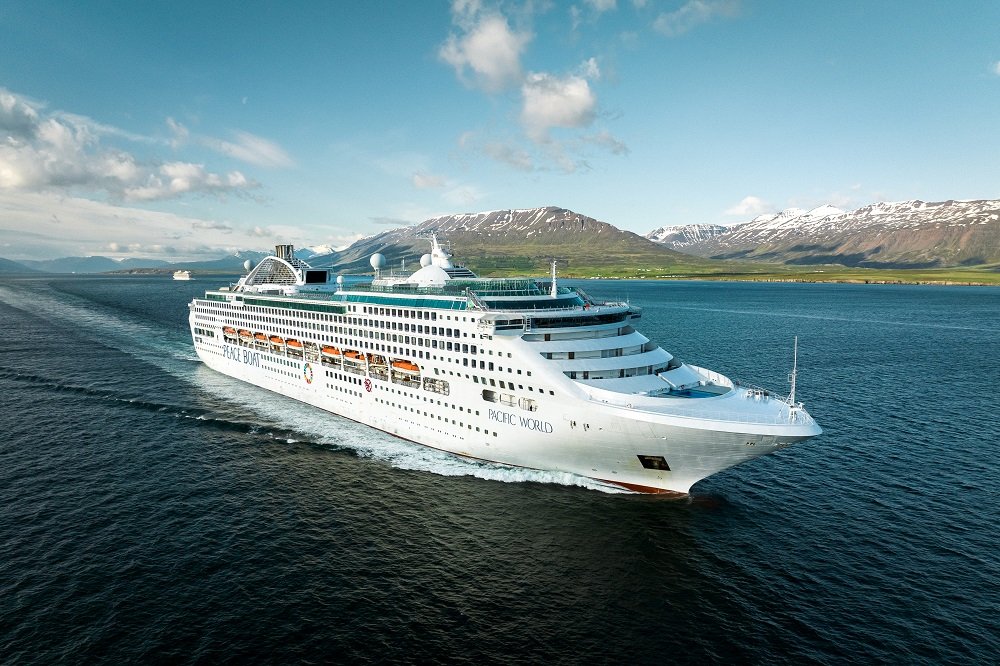
Peace Boat : The Ocean Steward
The Ocean Steward
The ocean gave me my first understanding of beauty. Then I watched it be treated as a drain. This is a story about what we owe the sea — and what happens when a ship full of people decide to act like stewards rather than spectators.
I grew up with the ocean as a given. From our family home in Haiti, the water was simply part of the landscape of childhood — impossibly blue, crystalline, the kind of clarity that lets you see straight to the ocean floor as though the sea itself were made of glass. It was not something we talked about protecting. It did not occur to us that it needed protecting. It was just there, the way the sky is just there: ancient, immovable, the backdrop against which everything else happened.
Then I came to America. And I saw what the ocean looks like here — brown in places, thick with debris, plastic bottles turning slow circles in the surf, a film on the waterline that the eye learns to stop registering because registering it is too uncomfortable. The contrast is not subtle. It is a confrontation. The same ocean. Two completely different relationships with it — one that understands the sea as something to be honored, and one that has quietly decided it is a drain.
What I have never been able to reconcile, since that first confrontation, is how deliberate it all feels. This is not neglect by oversight. The ocean is one of the great wonders of this planet — the system that produces more than half the oxygen we breathe, that absorbs over 90% of the heat our warming atmosphere generates, that sustains the livelihoods of three billion people. We know this. We have known this for a long time. And we have chosen, in policy and in practice, to treat it as a disposal site anyway.
That choice — and it is a choice — is what I want to talk about. Because I think if more travelers understood the ocean the way I understood it growing up in Haiti — as something alive, specific, and irreplaceable — they would travel very differently. And that is what this series is about.
What Peace Boat actually is — and why it matters.
Peace Boat is not a cruise company. That distinction matters more than it might initially seem. Founded in Japan in 1983, Peace Boat is an international NGO that uses a voyage-based model to advance peace, sustainability, and human rights — carrying activists, educators, youth leaders, and advocates around the world on a ship that functions simultaneously as a floating university, a diplomatic vessel, and a platform for direct global action.
Its credentials are unimpeachable. Peace Boat holds Special Consultative Status with the United Nations Economic and Social Council. It is an active partner in the United Nations Ocean Decade. Its ship sails with the logos of the UN Sustainable Development Goals and the International Campaign to Abolish Nuclear Weapons — the 2017 Nobel Peace Laureate — painted on its hull, visiting approximately 100 countries every year. Most recently, Peace Boat co-organized an official side event at the 2025 UN Ocean Conference in Nice, focused on mobilizing youth and emerging ocean professionals — a session that filled to capacity, standing room only.
At the center of Peace Boat's environmental work is its Ocean and Climate Youth Ambassador Programme — a flagship initiative that brings young leaders from Small Island Developing States onto the ship. These are young people from Fiji, Barbados, the Seychelles, Palau, and Timor-Leste — communities where the ocean's decline is not a distant policy concern but a present, daily, existential reality — given a platform to carry their message to citizens and governments across every port the ship enters.
This is the organization I have had the privilege of working alongside. And this June, in New York City, something significant is happening aboard that ship — for the very first time.
Most travelers have never been asked to reckon with that.
What we are actually
traveling through.
The numbers around ocean health have reached a point where they should stop being background information and start being central to how we make travel decisions. The ocean absorbs roughly a third of all the carbon dioxide human activity produces — and as that carbon dissolves into seawater, it is making the ocean more acidic, threatening the coral reefs that house 25% of all marine life. Our coral reefs are not decorative. They are foundational.
Meanwhile, the plastic crisis has moved well beyond the visible. Between 75 and 199 million tonnes of plastic waste currently sit in the world's oceans. More than 11 million tonnes enter every year. Microplastics have been found in the deepest ocean trenches, in Arctic ice sheets, and in 85% of the fish we eat. The Great Pacific Garbage Patch now covers an area twice the size of Texas and contains 1.8 trillion pieces of plastic. Without decisive intervention, plastic will outweigh fish in the ocean by 2050.
The tourism industry is not innocent in this. Coastal tourism generates enormous volumes of single-use plastic. Resort development destroys mangroves and coral — the very ecosystems that make a coastline beautiful enough to visit in the first place. The industry that profits most directly from the ocean's beauty is also among the forces accelerating its decline. That is the contradiction at the heart of sustainable travel that most of the industry prefers not to name directly. I am naming it because travelers who genuinely care deserve the clarity.
What drew me to Peace Boat's work was not just the scale of what they do — it was the methodology. They understand that environmental action without community is policy without teeth. The young people they bring onto that ship are not passengers. They are the argument: living proof that the communities most affected by ocean degradation are also the ones most capable of leading the response, if we give them the platform and the resources to do so. That is a model for how every travel organization should think about its relationship to the places it moves through.
The inaugural Ocean Gala.
Aboard the ship. In New York.
On the evening of June 10th — two days after United Nations World Oceans Day — Peace Boat US will host the first-ever Ocean Gala and Blue Innovation Reception aboard the Peace Boat ship, docked at the Manhattan Cruise Terminal. This is an inaugural event. There has never been one before. And the timing, the venue, and the guest list make it one of the most significant ocean-focused gatherings of the year in New York City.
The Gala will bring together partners from the United Nations, private sector leaders, youth ocean advocates, blue economy innovators, and civil society organizations — all aboard a ship that has circumnavigated the globe in service of exactly these values. The evening opens with the Ocean Gala at 5pm, transitioning into a Blue Innovation Reception at 7:30pm, with appetizers and drinks served onboard. The dress code is Blue Tie and ocean-inspired. Formal, purposeful, and unlike any event happening in this city this June.
Peace Boat US will also be announcing the inaugural Ocean Stewardship Awards for SDG 14: Life Below Water — celebrating the individuals, organizations, and innovators putting the ocean at the forefront of marine research, conservation, and nature-based solutions. The award alone signals what kind of room this will be.
LuxeTerre is proud to be part of this evening. And we want to bring our community with us. Use code LUXETERRE at checkout for $25 off your ticket.
The Ocean Gala &
Blue Innovation Reception
An evening onboard Peace Boat with UN partners, blue economy leaders, youth ocean advocates, and civil society — in celebration of World Oceans Day and the UN Decade of Ocean Science. Appetizers and drinks served onboard. Valid government-issued photo ID required. All attendees must register independently.
Use code LUXETERRE at checkout · Registration closes June 1 · Tickets not transferable
I believe the most powerful thing the conscious travel community can do right now is show up — physically, financially, and publicly — for the organizations doing the hardest work on ocean health. Peace Boat has been doing that work for over four decades. The Ocean Gala is an opportunity to stand in the same room as the people who are refusing to look away from what is happening to our seas, and to add your presence and your voice to that refusal.
Over the next four weeks, I will be bringing you deeper into this story — into what Peace Boat's programs actually look like on the ground, into what an evening like this means in the broader context of ocean governance, and into what LuxeTerre's collaboration with Peace Boat is building toward. This is week one. There is much more to come.
June 10th. Manhattan Cruise Terminal. Aboard Peace Boat. Code LUXETERRE for $25 off. Come be part of it.
The Green Gap
The Green Gap:
Why Reading About Sustainable Travel Isn't the Same as Doing It
The eco-travel internet has never been richer — or more overwhelming. Stunning guides, carbon calculators, destination manifestos. And yet, somehow, you're still on your own. There is a better way.
Let's give credit where it's due. The sustainable travel content ecosystem has done something remarkable: it has shifted consciousness at scale. Blogs like Sustainable Travel International, The Eco Experts, and Responsible Travel have educated millions of readers on the virtues of slow travel, carbon offsetting, community-based tourism, and the quiet devastation of overtourism. They have made "impact" a word that now belongs in the same sentence as "holiday."
And yet — there is a gap. A wide, logistically treacherous gap between knowing and doing.
The numbers tell a story the content doesn't. Intention is abundant. Execution is scarce. Because reading a beautifully written piece on the regenerative lodges of Costa Rica does not tell you which operator has LGBTQ-inclusive policies, or which private transfer company pays its drivers a living wage, or how to sequence an itinerary that minimizes internal flights while maximizing time. That work — the real work — is still left entirely to you.
It rarely tells you exactly how to get there.
There is no shortage of information. That, paradoxically, is the problem. A conscientious traveler researching an eco-minded trip to Japan might spend 30 hours across blogs, Reddit threads, certification databases, and hotel review sites — only to make booking decisions under pressure, with significant uncertainty still intact. The cognitive load is enormous, and the vetting process is, frankly, a full-time job.
Most sustainable travel content is not designed to close a booking. It is designed to inform a mindset. That's not a criticism — it's simply the nature of editorial work. The Condé Nast green hotel round-up does not know your travel dates, your dietary restrictions, your preferred pace of movement, or the fact that you need a wheelchair-accessible property with a spa that sources locally. The algorithm doesn't know you. The article was not written for you.
The LuxeTerre DifferenceThis is precisely where LuxeTerre Travel enters — and where the conversation changes entirely.
Powered by FORA, one of the most respected travel agency platforms in the industry, LuxeTerre Travel is not a content destination. It is a curation and execution partner. The distinction matters deeply. Where the eco-travel blog hands you a list and wishes you well, LuxeTerre takes the list, interrogates it, verifies it against current sustainability certifications, and builds a journey around your specific life — your values, your timeline, your definition of luxury, and your commitment to leaving places better than you found them.
Every recommendation is vetted. Every property is evaluated not just for aesthetics, but for ethics. Carbon impact. Community investment. Labor practices. Biodiversity commitments. These are not afterthoughts in the LuxeTerre framework — they are the framework.
And because LuxeTerre operates at the intersection of sustainability advocacy and genuine luxury fluency — rooted in years of global sustainability work and the Miss Earth USA ECO platform — the curation carries a credibility that no algorithm can replicate. This is not greenwashing dressed in beautiful photography. This is accountability with an itinerary attached.
The sustainable travel movement has earned its moment. The content is extraordinary. The intention across the traveling public is real. What has been missing — until now — is a partner who can translate that intention into a seamless, vetted, logistically flawless journey that doesn't ask you to become an expert just to take a vacation.
You've done the reading. Let LuxeTerre handle the rest.
Your values, fully itineraried.
Bespoke sustainable travel curation for the intentional luxury traveler. No guesswork. No greenwashing. Just beautifully considered journeys.
Plan Your Journey →